

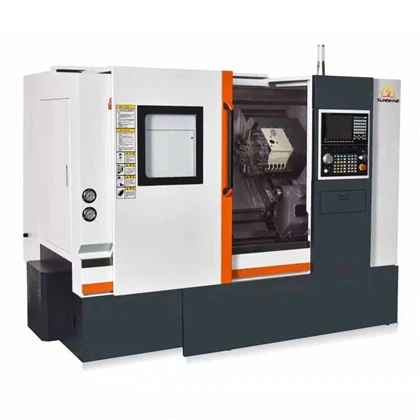
What is Slant Bed CNC Lathe
Slant-bed CNC lathes are high-precision, high-efficiency automated machine tools. Their bed guideways intersect the ground plane at an angle (common angles are 30°, 45°, 60°, and 75°), creating a right-angled triangle. Slant-bed CNC lathes can process shafts and discs, threads, arcs, cones, and internal and external surfaces of rotating bodies, providing efficient, high-volume, and high-precision machining of rotating parts.
-

Slant Bed Gearbox Precision Machining CNC Lathe
The slant bed of the Slant Bed Gearbox Precision Machining CNC Lathe has two guide rails whose plane intersects the ground plane at a certain angle. Common angles include 30°, 45°, 60°, and 75°. This Add to Inquiry -
Turning And Milling Compound Machine Tool Manufacturer
We are a manufacturer specializing in the research, development, manufacturing, sales, and service of CNC turning and milling machines. We offer customized services based on the workpiece being Add to Inquiry -
Multifunctional Automatic Cutting Slant Rail CNC Lathe
As a high-precision, high-efficiency automated machining equipment, the multifunctional automatic slant-road CNC lathe is widely used in precision machining fields such as aerospace, electronics, Add to Inquiry -
Hydraulic Clamping CNC Slant Lathe
The Hydraulic clamping CNC slant lathe is an automated machining equipment in modern manufacturing, characterized by its high precision and high stability. The Hydraulic clamping CNC slant lathe bed Add to Inquiry -
Slant Turn CNC Lathe
The TCK slant turner is a high-speed, precision CNC lathe. The CNC system can simultaneously control the X and Z axes, enabling rapid and automatic machining of ferrous metals, non-ferrous metals, Add to Inquiry -
CNC Milling And Turning Composite Slant Bed Machine Tool
CNC milling and turning slant bed machine tools are high-end machining equipment in modern manufacturing that integrates turning and milling functions. Through a highly integrated CNC system, they Add to Inquiry -
Metal Parts Processing CNC Slant-Bed Lathe
The slant bed CNC lathe features a bed that is tilted at 45° to the horizontal plane, forming a right-angled triangular structure. This layout significantly increases the length of the X-axis slide, Add to Inquiry -
CNC Slant Lathe
The CNC Slant Lathe features a 45° slant bed structure, with the bed, legs, and water tank made of a single piece of casting. Combined with a thick base, this significantly enhances the machine's Add to Inquiry -
Customized Slant Rail Lathe
The Customized Slant Rail Lathes features a 45° slant bed structure, with the bed, legs, and water tank made of a single piece of casting. Combined with a wide and thick base, this significantly Add to Inquiry -
CNC Slant Bed Lathe For Machining Complex Parts
The layout design of the slant-bed CNC lathe minimizes the influence of gravity on the ball screw in the X-direction, resulting in almost zero backlash during transmission and thus improving Add to Inquiry -
Slant Bed CNC Lathe For Heavy-duty Cutting
The three axes of the slant bed CNC lathe for heavy-duty cutting use linear guide rails, offering high rigidity, high positioning accuracy, low noise, and low friction characteristics, enabling rapid Add to Inquiry -
CNC Slant Bed Lathe For Metal Workpiece Turning
This CNC slant bed lathe for metal part turning is suitable for various mechanical processing industries and can mill flat surfaces, grooves, gears, threads, splined shafts, and complex contoured Add to Inquiry




Advantages of Slant bed cNC lathe
Highly Rigid
The slant-bed is a right-angled triangle with a cross-sectional area over 30% larger than a flat-bed of the same specification. This significantly improves bending and torsional rigidity, making it suitable for machining large shafts and discs. The bed utilizes resin sand molding and a secondary artificial aging treatment to eliminate internal stresses, ensuring long-term deformation and superior precision retention compared to flat-bed models.
High stability
The spindle box and machine bed utilize a highly rigid connection to reduce vibration and ensure a surface roughness Ra ≤ 0.8μm. The automatic lubrication system provides timed, quantitative lubrication to minimize wear on the guideways and lead screws. The fully enclosed structure and coolant circulation effectively control machine temperature rise, achieving a thermal deformation error of ≤ 0.01mm/8h.
High Precision
The spindle of this slant-bed CNC lathe utilizes large-diameter precision angular contact ball bearings or a combination of thrust ball bearings and cylindrical roller bearings. It boasts a maximum speed of 5000 rpm and high low-speed torque, making it suitable for heavy-duty cutting.
Efficient Chip Removal
The bed's guideways are angled to the ground, allowing chips to automatically slide to the chip removal opening under gravity. Combined with a side-mounted chain-type chip conveyor, this provides 24-hour continuous chip removal, reducing manual cleaning time and increasing chip removal efficiency by over 50%. It is particularly suitable for machining difficult-to-cut materials such as stainless steel and titanium alloys.
Products Parameters
| Specification | unit | TCK4550 | TCK4556-500 | TCK4556-1000 | TCK4572-1500 |
| Swing over bed | mm | 500 | 560 | 560 | 720 |
| Swing over slide | mm | 360 | 350 | 350 | 620 |
| Max machining length | mm | 500 | 500 | 1000 | 1500 |
| Spindle motor power | KW | 11-15 | 11-15 | 30-37 | 30-37 |
| Diameter of spindle through hole | mm | 65 | 65 | 65 | 80 |
| Max spindle speed | rpm | 50-4500/177 | 50-4500/177 | 50-4500/177 | 50-3500/145 |
| Tilt angle | deg | 45 | 45 | 45 | 45 |
| Hydraulic chuck | - | 8"/10" | 8"/10" | 15"/18"/21" | 15"/18"/21" |
| X-axis travel | Kw | 200 | 200 | 200 | 420 |
| Z-axis travel | mm | 550 | 560 | 1050 | 1550 |
| Tailstock sleeve diameter / travel | mm | 450 | 450 | 900 | 1650 |
| Sleeve taper | MT | 5 | 5 | 6 | 6 |
| X/Z fast movement | m/min | 30/30 | 30/30 | 30/30 | 12/16 |
| Overall dimensions | mm | 2300*1600*1800 | 2300*1600*1800 | 5000*2400*2800 | 6000*2400*2800 |
| Machine weight (approx) | Kg | 3600 | 3600 | 4500 | 5000 |
Why Choose Us
High quality
Our products are manufactured or executed to very high standards, using the finest materials and manufacturing processes.
Rich experience
Dedicated to strict quality control and attentive customer service, our experienced staff is always available to discuss your requirements and ensure complete customer satisfaction.
Quality control
We have professional personnel to monitor the production process, inspect the products and ensure that the final product meets the required quality level standards, guidelines and specifications.
24h online service
We try and respond to all concerns within 24 hours and our teams are always at your disposal in case of any emergencies.
Types of Slant bed cNC lathe
Standard Slant-Bed CNC Lathe
Equipped with a multi-station turret or powered turret, this standard slant-bed CNC lathe supports machining complex workpieces such as straight and inclined cylinders, circular arcs, and various threads, grooves, and worm gears. Featuring linear and circular interpolation and various compensation functions, this standard slant-bed CNC lathe is suitable for machining a wide variety of small and medium-sized batches of precision and complex rotating parts.
Heavy-Duty Slant-Bed CNC Lathe
This heavy-duty slant-bed CNC lathe features high spindle torque and high spindle speed. Its bed is constructed of high-grade cast iron with a 45°/60° slant, a single-piece casting for superior rigidity. This heavy-duty slant-bed CNC lathe supports heavy-duty cutting (such as high-temperature alloys, titanium alloys, stainless steel, and other difficult-to-machine materials), meeting both rough and fine machining requirements. It is suitable for heavy-duty parts machining in industries such as shipbuilding, energy, and heavy machinery.

Turn-Mill Combination Slant-Bed CNC Lathe
Turn-Mill Combination Slant-Bed CNC Lathes offer both turning and milling capabilities, enabling them to complete multiple operations, including turning, milling, boring, drilling, and tapping, in a single setup. This slant-bed CNC lathe supports machining complex curved surfaces (such as 3D surfaces and special-shaped holes), reducing setup times and improving machining accuracy and productivity. It is suitable for machining complex parts in the aviation, aerospace, and automotive industries.
Customizable Slant-Bed CNC Lathe
Designed and manufactured to meet specific user requirements, these customizable CNC lathes utilize modular design, expanded functionality, and structural adjustments to meet the machining needs of diverse industries and workpieces. Customizable multi-station toolholders and powered toolholders enable multiple processes to be completed in a single setup, reducing workpiece transfers and setup time, thereby improving machining efficiency.
How to Choose Slant bed cNC lathe
Determine your application needs
Before purchasing a slant-bed CNC lathe, it's crucial to understand your specific application requirements. Consider the type of material you will be machining, the size and weight of the workpiece, and the complexity of the parts you will be producing.
Working principle
The size and weight of a slant-bed CNC lathe are key factors affecting its performance and usability. For example, a smaller machine may be better suited for lighter applications, while a larger one can handle heavier workpieces and increase production output.
Select a reputable manufacturer
The quality and performance of a slant-bed CNC lathe largely depends on the manufacturer. Choosing a reputable manufacturer known for producing high-quality machine tools is crucial. You should research the company's background, product history, and customer reviews to ensure you're making a wise investment.
Consider the cost and efficiency
Finally, consider the cost and efficiency of the slant-bed CNC lathe you plan to purchase. While a more expensive machine may offer better performance and greater precision, it may not be the most cost-effective option for your business. It's crucial to evaluate the return on investment and determine whether the added cost will significantly improve productivity and quality.
Material of slant bed CNC lathe
The bed of the slant-bed CNC lathe is made of HT300. It is cast using a resin sand casting process and features a well-defined internal rib layout. The guideways utilize imported 35-gauge linear ball guides, which offer improved feed accuracy, low friction, excellent rigidity, and high resistance to vibration and deformation. This allows users to achieve higher machining accuracy, faster traverse speeds, and higher production efficiency.

Application of slant bed CNC lathe
Automotive manufacturing industry
In the automotive sector, slant-bed CNC lathes can process key components such as drive shafts, spindles, rotor shafts, discs, pulleys, and gears. They support multiple processes in a single clamping cycle, improving production efficiency.
01
Aerospace field
Slant-bed CNC lathes are widely used in the aerospace industry, machining high-precision, high-strength aircraft engine parts and precision structural components, meeting the processing requirements of aerospace materials such as titanium alloys and high-temperature alloys.
02
Mechanical Manufacturing
In the machinery manufacturing industry, slant-bed CNC lathes are used to machine general-purpose mechanical parts such as shafts, discs, and sleeves, as well as parts with complex curved surfaces such as worms, threads, and spheres.
03
Mold manufacturing industry
Slant-bed CNC lathes are widely used in mold manufacturing, such as high-precision machining of injection molds, die-casting molds, and forging molds. They support integrated machining of multiple processes and reduce setup times.
04
Electronic consumer goods industry
Slant-bed CNC lathes process precision electronic components such as watch parts, optical components, and communications equipment, meeting the demands of high-precision, small-batch production.
05
Process of Slant bed CNC lathe
Preparation
Before starting machining, the operator needs to perform a series of checks and settings on the machine tool. First, check whether all parts of the machine tool are intact, such as guide rails, cutting tools, spindles, etc. Then, set the compensation value of the tool to ensure the accurate position of the tool during processing. In addition, the corresponding processing parameters must be set according to the drawings of the processed parts, such as spindle speed, feed speed, tool path, etc.
Clamp the workpiece
Fixing the workpiece to be processed on the machine tool is a critical step in the machining process. There are many ways to clamp workpieces, such as manual clamping, pneumatic clamping, hydraulic clamping, etc. When clamping, it is necessary to ensure the position accuracy of the workpiece and the stability of the workpiece during processing. For large workpieces or workpieces with complex shapes, special clamps or universal clamps need to be used for fixation.
Tool selection and setting
Select the appropriate tool according to the requirements of the processed parts. The selection of cutting tools is mainly based on factors such as processing materials, processing technology, and processing surface quality. After selecting the tool, you also need to set the tool's compensation value to ensure the accurate position of the tool during processing. In addition, the wear of the cutting tools must be checked and seriously worn cutting tools should be replaced in time to ensure the processing quality.
Programming
The machining process on slant-bed CNC lathes is performed through programming. During programming, the operator creates a machining program based on the part drawing. This program primarily includes coordinate system setup, tool path planning, feed rate and spindle speed settings, and tool compensation settings. During programming, it is important to fully consider potential machining issues, such as tool interference and the allocation of machining allowances.
Processing
After completing these preparatory steps, the slant-bed CNC lathe can be started for machining. The operator enters the machining program through the control panel, and the machine automatically executes the machining process. During machining, the operator must closely monitor the process and take prompt action if any anomalies are detected. Furthermore, tool wear must be regularly inspected, and severely worn tools should be replaced promptly.
Handling after processing
After processing, the processed parts need to be inspected to check whether the processing quality meets the requirements. If there is a quality problem, the cause needs to be analyzed and the processing parameters should be adjusted or reprogrammed in a timely manner. At the same time, the machine tool must be cleaned and maintained, such as removing chips, wiping the machine tool, adding lubricating oil, etc., to ensure the normal operation of the machine tool.
Things to Note When Using Slant bed CNC lathe
1. Safety first
Safety is the first and foremost consideration when using a slant-bed CNC lathe. These machines operate at high speeds and high torques, making them extremely dangerous without proper safety measures. Always wear necessary personal protective equipment (PPE), such as goggles, gloves, and a dust mask. Ensure your work area is well-lit and free of clutter. Always keep machine guards in place and never remove them while the machine is operating.
2. Proper setup
Before using a slant-bed CNC lathe, it's crucial to properly set up the machine. This includes inspecting the cutting tools and ensuring they are in good condition. The cutting tools should be securely mounted, and the correct cutting parameters should be entered into the CNC control system. The workpiece should also be securely clamped in the chuck or fixture, and the correct speed and feed rates should be selected for the material being machined.
3. Calibration
Calibration is a crucial part of using a slant-bed CNC lathe. Regular calibration ensures the accuracy and precision of the machine. This process should be performed by trained personnel using calibrated gauges or probes. Calibration should be performed at least monthly or whenever the machine is moved or undergoing maintenance.
4. Programming
Slant-bed CNC lathes require programming to operate. A program is a set of instructions that tells the machine how to perform the desired machining operations. A thorough understanding of CNC programming is essential to operating the machine efficiently. Programs should be carefully written, checked for errors, and tested in computer simulations before running on the machine.
5. Machine maintenance
Regular maintenance of your slant-bed CNC lathe is essential to ensure optimal performance and longevity. This includes daily inspections for any signs of damage or wear, such as broken tools or worn bearings. Regular cleaning of the machine and its components is also crucial to prevent dust and debris from accumulating and causing damage. More comprehensive maintenance tasks, such as oil changes or replacement of worn parts, should be performed according to the machine's maintenance schedule.
How to Maintain Slant bed CNC lathe

01
Cleaning and lubrication
Regular cleaning and lubrication of your slant-bed CNC lathe is crucial to maintaining its performance and longevity. Use the manufacturer's recommended cleaning fluid to remove any dust, debris, and coolant residue from machine surfaces and components. After cleaning, apply a suitable lubricant to the machine's moving parts, such as guideways, bearings, and gears.
02
Cutting tool management
Proper cutting tool management on your slant-bed CNC lathe is essential to achieving optimal cutting performance and avoiding machine damage. Regularly inspect the condition of your cutting tools and replace them when necessary. Ensure you use the correct type and size of cutting tool for the job, and always follow the manufacturer's recommendations for tool use and maintenance.


03
Safety precautions
Safety is always the top priority when using a slant-bed CNC lathe. Make sure all lathe safety devices, such as emergency stop buttons, are in working order. Keep your work area clean and free of debris, and always wear appropriate personal protective equipment (PPE), such as goggles, gloves, and a dust mask.
04
Training and documentation
Proper maintenance of a slant-bed CNC lathe requires knowledge and skills. Ensure all operators are properly trained in machine use and maintenance. Keep accurate records of maintenance tasks, including date, time, and personnel involved. These records will help you identify patterns and trends, allowing you to prevent potential problems before they occur.

Our Factory
● More than 20 years of experience in mechanical equipment manufacturing factory
● 24-hour online service at any time
● 24-month warranty
● Support ODM OEM
● Provide free workpiece processing test
● Provide a full range of solutions for mechanical processing projects
● Pass strict quality control and multiple testing processes
● Trade with customers in more than 150 countries around the world


FAQ
Q: What is a slant bed CNC lathe?
A: The inclined-bed CNC lathe is a precision machining equipment with a guideway inclined at 30°-45°. Through its gravity chip removal design and triangular stabilization structure, it achieves high-speed cutting, high precision and compact layout. It is optimized for the automated and efficient production of small and medium-sized rotating parts (such as aluminum wheels and medical parts).
Q: What are the main components of a slant bed CNC lathe?
A: The main components of a slant-bed CNC lathe include the bed, spindle system, turret system, guideways and slides, feed system, CNC system, tailstock, chip removal and lubrication systems, and protective devices.
Q: What are the advantages of a flat bed CNC lathe?
A: Slant-bed CNC lathes utilize an angled bed design, significantly enhancing overall machine rigidity and effectively resisting cutting vibration. They also utilize gravity to automatically shed chips, reducing cleanup time and preventing secondary cutting damage.
Q: What are the different types of slant-bed CNC lathes?
A: There are several types of slant-bed CNC lathes, such as standard slant-bed CNC lathes, long-axis slant-bed CNC lathes, and turn-mill slant-bed CNC lathes. Each type is designed for specific applications and offers different features and capabilities.
Q: How does a slant-bed CNC lathe work?
A: A slant-bed CNC lathe works by following a series of commands programmed into its control system. These commands tell the machine where to move the cutting tool and how to perform the desired machining operation.
Q: What are the advantages of a slant-bed CNC lathe?
A: Slant-bed CNC lathes significantly improve machining efficiency and product quality thanks to their highly rigid structure, efficient chip evacuation, multi-process integrated machining capabilities, and high-precision stability.
Q: What is the maximum workpiece size that can be machined on a slant-bed CNC lathe?
A: The maximum workpiece size that can be machined on a slant-bed CNC lathe depends on the size of the machine. Generally, the larger the machine, the larger the workpiece it can handle.
Q: What is the difference between a slant-bed CNC lathe and a CNC vertical lathe?
A: A slant-bed CNC lathe features a tilted bed design, allowing the tool to cut from an angled top, resulting in smooth spindle operation and strong vibration resistance. CNC vertical lathes, on the other hand, feature a vertical spindle layout, with the workpiece rotating on a horizontal worktable and the tool fed vertically.
Q: How does a slant-bed CNC lathee work?
A: A slant-bed CNC lathe works by using a computer program to control the movement of the machine tool and the tools used to machine the workpiece. The program is typically written in a language called g-code, which is a standardized language used to control cnc machines.
Q: What parts are suitable for machining with a slant-bed CNC lathe?
A: Slant-bed CNC lathes, with their highly rigid structure, multi-station turret, and high-precision control system, are particularly suitable for machining rotating parts such as shafts (such as drive shafts and gear shafts), discs (such as flanges and end caps), and sleeves (such as hydraulic cylinder sleeves).
Q: How should I choose a slant-bed CNC lathe?
A: When choosing a slant-bed CNC lathe, you need to comprehensively consider the processing requirements (such as part size, precision, and material), machine tool rigidity, turret configuration, CNC system compatibility, and brand after-sales service. At the same time, you should balance performance and cost based on your budget, and give priority to models with modular design and strong scalability to adapt to future production upgrades.
Q: What are the different types of tools for slant-bed CNC lathes?
A: Slant-bed CNC lathes offer a wide range of tool types. These tools can be categorized by application, including external turning tools, internal turning tools, grooving tools, and threading tools, meeting various machining needs.
Q: How do I choose the rightslant-bed CNC lathe for my application?
A: When choosing a slant-bed CNC lathe for your application, you should consider the size and complexity of the parts you need to machine, the material you will be working with, and the budget you have available for the machine.
Q: Which is better, a slant-bed CNC lathe or a CNC vertical lathe?
A: Slant-bed CNC lathes offer superior precision, flexibility, and automation for machining rotating parts; CNC vertical lathes offer greater rigidity and ease of operation for machining large disc-type parts. The choice should be made based on a comprehensive analysis of part size, precision requirements, and production scenarios.
Q: What is the difference between a CNC slant-bed CNC lathe and a CNC lathe?
A: The slant-bed CNC lathe is a special type of CNC lathe. Compared with ordinary flat-bed CNC lathes, the slant-bed CNC lathe has significant differences in structural design, processing performance and application scenarios. Its core advantages lie in higher precision, better chip removal performance and stronger automation potential.
Q: Why are slant-bed CNC lathes better than conventional lathes?
A: Compared to conventional lathes, slant-bed CNC lathes, thanks to their tilted bed design, offer significantly improved rigidity, vibration resistance, and chip removal capabilities. This results in comprehensive improvements in machining accuracy, efficiency, and automation, making them particularly suitable for mass production of high-precision, complex parts.
Q: What are the safety precautions for a slant-bed CNC lathe?
A: When using slant-bed CNC lathe, safe operating procedures should be followed, such as wearing protective equipment, checking equipment regularly, etc.
Q: How to improve the efficiency of a slant-bed CNC lathe?
A: Improving the efficiency of slant-bed CNC lathe mainly includes optimizing processing technology, improving operator skills, and rationally configuring tools.
Q: What are the common problems of a slant-bed CNC lathe?
A: Common faults in slant-bed CNC lathe include control system faults, spindle faults, tool faults, etc.
Q: How to troubleshoot a slant-bed CNC lathe?
A: Faults on slant-bed CNC lathe can be eliminated through inspection, replacement, repair and other methods.
SUNSHINE, established in 1996, is one of the leading slant bed cnc lathe manufacturers and suppliers in China. All of our equipments are made under strict quality control and management system. Please rest assured to wholesale the customized slant bed cnc lathe from us.
